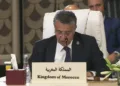
Rabat – The Algerian regime, the primary support of the separatist Polisario Front, has received a significant blow along with the African Union’s decision this week to exclude the separatist group from meetings between the continental organization and its international partners.
This latest development was acted on July 19 as the two-day 45th session of the African Union Executive Council, which convened in Accra on July 18-19, overwhelmingly decided, with (52 votes in favor out of 54) to exclude the separatist group from the pan-African body’s meetings with international partners.
Not surprisingly, the decision shocked and outraged the Polisario leadership and the separatist group’s devout supporters and sponsors.
For observers, the African bloc’s decision does not only point to the alarmingly waning support for the separatist group’s dream of creating an independent state in the Western Sahara region in southern Morocco.
It also speaks of a shocking defeat for the Algerian regime, Algerian political analyst Oualid Kebir told Morocco World News (MWN) today, arguing that the AU’s move reflects Algeria’s failure, despite decades of anti-Moroccan lobbying at the AU, to get the pan-African bloc to support Polisario’s “Sahrawi cause.”
“The new decision stipulates that only African Union member states can participate in major international forums where the African Union meets its partners,” Kebir said.
The growing frustrations of Algerian diplomacy
Following the vote, Algeria’s Minister of Foreign Affairs Ahmed Attaf reacted with anger and dismissiveness; he furiously lamented the decision while taking a desperate swipe at Morocco’s supposed weaponization of the AU. The separatist group’s exclusion from such high-ranking meetings shows that some parties “desire to institutionalize a policy of exclusion,” Attaf fumed.
He added, “Or rather the exclusion of a founding member of our organization and preventing their participation in the Tokyo International Conference on African Development (TICAD).”
For Kebir, Attaf’s remarks show a “deep sense of pain and an explicit acknowledgment of the resounding diplomatic defeat” suffered by his country.
“This means that the Sahrawi Arab Democratic Republic (SADR) does not have the right to participate in summits concerning African Union partnerships with global countries,” Kebir said, noting that the decision constitutes a very strong blow to the regime that sek to implement agendas not conducive to a unified African bloc.
“The decision reflects a historic shift in the Union’s policy towards this movement, which was imposed by the regime within the African body as a ‘founding member,’ relying at the time on a policy of draining treasury funds through bribery,” the analyst argued.
The AU’s move notably means that the self-proclaimed SADR now only enjoys inconsequential weight and a negligible level of recognition or support in Africa, he continued, stressing: “Its expulsion from the AU has become an urgent necessity because it lacks state attributes and operates illegally in Tindouf.”
Morocco rejoined the AU in January 2017 after over three decades of absence from the continental bloc, ending “the policy of the empty seat” that Algeria and the Polisario Front keenly exploited to advocate for the normalization of Morocco-bashing within the AU while laying the groundwork for continent-wise support for the separatist group’s challenge to Morocco’s territorial integrity.
Echoing Kebir, Sabri Lhou, a lawyer and expert on international law, migration issues, and the Western Sahara conflict, told MWN that the AU is now going through the right path against division and separatism.
“The AU is now convinced that separatists and more separatism will undermine the African Union and unity,” Lhou stressed.
This is a new shift from the AU, which is now adopting the kind of pragmatism and diplomatic realism endorsed by the UN-led political process in the Sahara dossier.
Morocco’s 2007 Autonomy Plan changed the game
Critically, since Morocco presented its Autonomy Plan to the UN Security Council in 2007, all UN resolutions on the Sahara affair over the past nearly two decades have essentially embraced the Moroccan plan as the best and most viable route to politically feasible and sustainable settlement of the lingering conflict.
This means the AU’s decision comes against a background of what some have called a diplomatic procession for Morocco in the past decade.
And so, Polisario and its Algerian and other international sponsors rightly see the move as a dangerous harbinger for what is shaping out to be the AU’s coming turn — following in the footsteps of the UN Security Council and countries like the US and Spain — to potentially consider Polisario’s dream of Sahrawi independence an impossible and dangerous course of action in a fragile region.
As Kebir sees it, the decision is a victory for Morocco and the AU’s increasingly visible opposition to separatism in Africa.
Lhou, who is also the president of the Strategic Thinking Academy, agreed, describing the decision as reflecting how Morocco’s diplomatic efforts have achieved “momentum in record time.”
While the Polisario and Algeria used to carry significant currency in AU circles, which they almost “took hostages” for large spans of Morocco’s absence from the organization to serve their separatist agenda, Lhou argued, “can say now the AU has been freed from this exploitation.”
Tamba François Koundouno contributed to this story.