Marrakech – In the wake of the devastating Al Haouz earthquake that struck Morocco’s rural Rhamna province, located north of Marrakech, in September 2023, residents are harnessing the power of traditional know-how to revitalize the local economy and create jobs, according to a recent report by the French Development Agency (AFD).
In the northern province of Marrakech, many inhabitants continue to struggle to make ends meet in dilapidated villages.
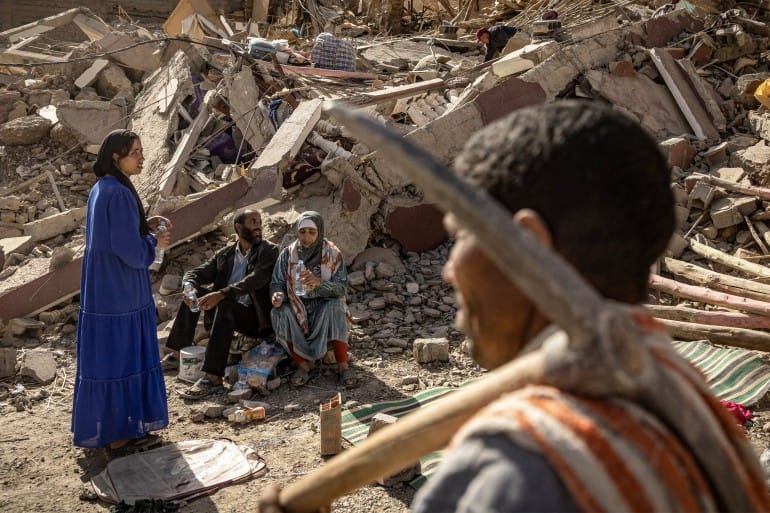
The quake, which damaged over 50,000 homes and decimated critical infrastructure, left many residents deeply impoverished after losing their property and sources of income.
The destruction of agricultural, road, and health infrastructure has also had consequences on the education of the community’s youngest. Within this context, the report mentions that “there are many challenges in this region.”
However, the AFD says that by capitalizing on local resources and cultural heritage, Rhamna is finding a path to recovery through sustainable development initiatives.
“To revive the local economy, create new jobs, and encourage education and the entry of young people into working life, the inhabitants of the region have been mobilizing for several years to take advantage of local resources and culture,” the report states.
One such project is a massive greenhouse in the heart of Rhamna, that will serve as a nursery producing horticultural, ornamental, and forestry plants.
Managed by an economic interest group, it will supply local production to the town and farmers in the region while creating jobs targeted at the economically vulnerable.
The Women’s Initiative Association of Rhamna (AIFR) has also launched a “House of Wool” cooperative where traditional weaving techniques are being passed down to younger generations.
Fatima Boumehdi, a lifelong weaver who learned the craft from her mother, says the co-op normally employs six people but can mobilize up to 50 women when large orders come in.
In the face of the material losses suffered as a result of the 2023 earthquake, numerous reconstruction projects have been launched.
The AIFR is supporting the initiative of Rachid Bouqartacha, an architect specializing in construction using local materials, who is teaching traditional building methods to young volunteers.
“The initiative aims not only to rebuild the villages damaged by the earthquake, but also to create jobs and train young people in these craft practices, while respecting current climate issues,” the AFD report notes.
These ancestral methods are efficient and inexpensive, as they only require simple and ecological materials. They thus respond to environmental challenges.
Bouqartacha says that once trained, “the young people will return to their villages and form small businesses or cooperatives to help with the reconstruction.”
The AFD emphasizes that these projects demonstrate the potential of traditional trades to drive opportunities by providing economically and environmentally sound solutions to today’s challenges.
The report concludes that is why the agency is supporting this multi-sector project as part of its priority to contribute to the social and ecological transition of territories.
Read also: Morocco to Launch New Renovation Project for Historical Monuments Damaged by Al Haouz Earthquake