Rabat- Irregular migration has been an ongoing crisis in Morocco, but last week saw an exceptional incident.
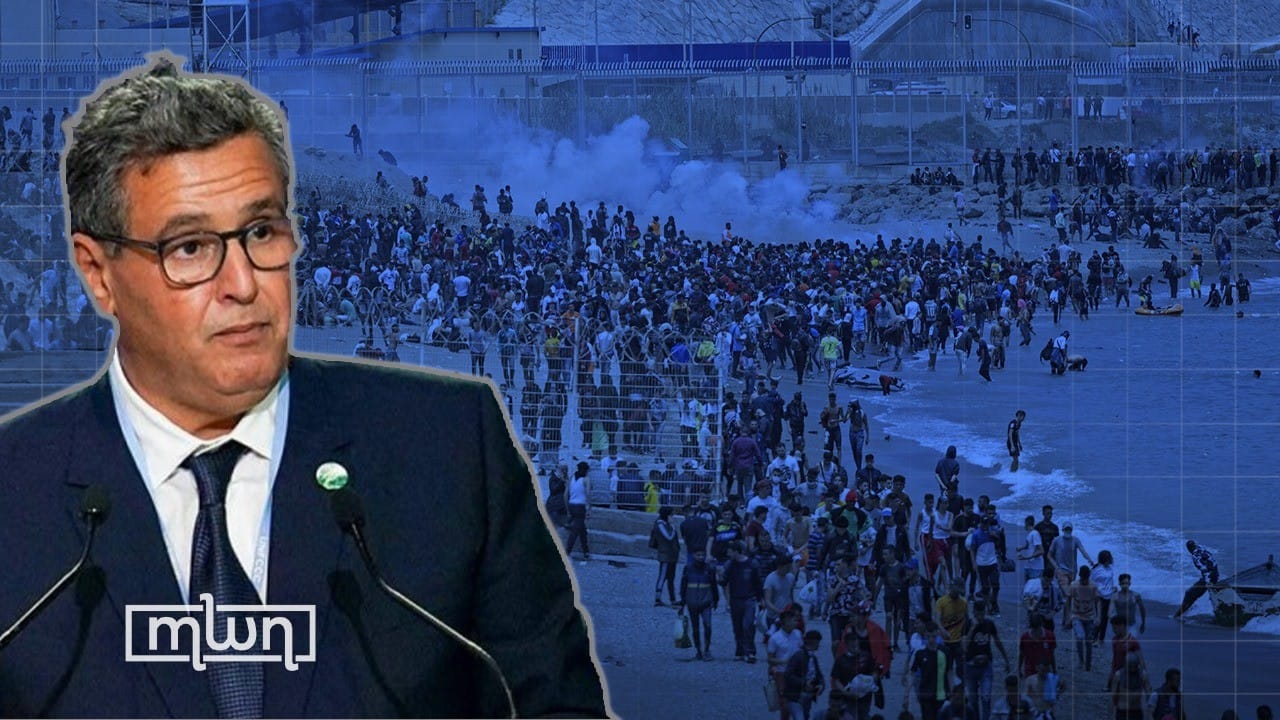
Northern regions, particularly Fnideq, a city 34 kilometers from Tetouan, have become targets to hundreds of young people desperate to reach Europe despite the perilous journey they face.
Many attempt to cross the fence between the Spanish enclaves of Ceuta and Melilla, while others risk swimming miles in harrowing conditions, braving the cold sea in their dangerous bid to reach Europe.
Some “succeed” in the crossing, but their ordeal is far from over.
When arrested after reaching the Spanish enclaves, they face detention in centers, mistreatment by police, and eventual deportation.
Meanwhile, others remain missing, while the truly tragic cases result in migrants dying in the crossing. These victims’ identities are often revealed only through DNA testing of their clothing — if not eroded by sea salt, much like their unrecognizable faces.
Morocco’s geostrategic position has made it a hotspot for people hungry for better opportunities. As a transit and a destination, the country has received tens of thousands of migrants seeking to reach Europe.
The North African country attracts not only sub-Saharan migrants, but also neighboring migrants from Algeria, and various groups from other countries.
Last week’s September 15 migration attempt, which is being dubbed in the media as the “Great Escape,” saw Morocco’s irregular migration challenge come to a particular boiling point. Disturbing footage has surfaced and been circulated online showing scenes of riots, arrests, and vandalism across Fnideq, where security services units have been deployed to address the situation.
An insidious issue
Amid the chaos, a far more challenging issue has emerged: the manipulation of the crisis by external forces.
In particular, Algerian media outlets have seized on Morocco’s irregular migration issue — not only as an opportunity to address the real humanitarian crisis but rather to stoke tensions, further exacerbating the situation.
Many Algerian media outlets, especially those affiliated with the regime, have fabricated stories and used misleading visuals, including footage from unrelated conflicts, notably one being the Israeli genocide in Gaza.
AL24News is part of the Algerian news outlets that used footage showing scenes from Gaza, depicting arrested Palestinians naked and bruised.
Although the photo has Gaza in the scroller headline, the overall caption inaccurately misleads readers to believe that the photo was taken in Morocco. The news outlet also used a photo of a naked youth, toting the viral rumor that the photos were taken in Fnideq.
“Harsh scenes of Moroccan youths stripped of their clothes and bearing signs of torture on their bodies… and the accusation: ‘the desire to live!’ the news outlet claimed.
However, local sources in the M’diq-Fnideq prefecture have insisted that the circulated photos and video clips are not related to the ongoing mass migration crisis in Fnideq.
The Public Prosecutor’s Office at the Tetouan Court of Appeal also ordered an investigation into the origin and circumstances surrounding the online sharing of photographs that appear to show alleged migrants in vulnerable conditions. The photos have sparked serious alarm in Moroccan social media circles.
With public awareness and media literacy alarmingly lagging in an age where AI can generate or manipulate content with ease, many are left dangerously vulnerable to these false narratives.
Only a handful of activists and journalists have taken it upon themselves, or to say the least, attempt to raise awareness of the situation — a task that the Algerian government’s communication channels should have prioritized.
Reports have surfaced identifying Algerians and other nationalities as active participants in the mass migration attempts, with some even falsely claiming to be Moroccan.
One of the viral videos online shows a woman in tears, apparently posing as Moroccan and appealing to King Mohammed VI to intervene, claiming that she would do anything to migrate due to the challenges she faces as a result of poverty.
However, in another interview, she admitted that she is Algerian living in Morocco. Her dialect in the video also appears to be distinctly Algerian, raising questions about the authenticity of her initial plea.
“This is my country, long live the King, when my father died my mother brought us here. I don’t want to go back to Algeria,” she said in the interview.
When a journalist asked what her demands were, she said “they need to find us a job.”
A reporter from the scene said there were many nationals, not just Moroccans, attempting to cross into the Spanish enclaves, including many from Algeria.
Nationals from Tunisia, Yemen, Syria, and Egypt in addition to sub-Saharans were also engaged in the mass migration attempt.
Further showcasing Algeria’s shared role in the situation, Algerian social networks have been also engaged in encouraging their youth to join this migration wave, raising many questions.
Many have shared screenshots from fake accounts, attributed to Algerian-orchestrated pages, urging people to participate in mass migration attempts.
Are external forces deliberately fueling the crisis?
Oualid Kebir, an Algerian journalist and political analyst, views this manipulation as indicative of direct involvement by Algeria’s regime in Morocco’s internal affairs.
In addition to his viral posts about Algeria’s regime involvement, Kebir discussed his analysis in an interview with Morocco World News (MWN).
“Of course, the regime is involved in what happened in Fnideq, and I believe that their actions were part of a strategy to cover up their internal and external failures,” Kebir said.
Kebir also warned that the Algerian regime is using individuals within Morocco to execute its Morocco-bashing agenda.
“This narrative is widely promoted by followers of the Algerian military regime, as well as some Moroccan accounts that are likely aligned with it,” Kebir remarked, referencing the regime’s full coverage of the images and videos from Fnideq.
For Kebir, the dire situation requires rationalism, and further he stressed that Morocco needs to avoid becoming an indirect tool of the Algerian regime.
“It [Morocco] should not allow these losses to be twisted into diplomatic gains for Algeria, especially concerning the issue of Moroccan Sahara, by promoting the narrative that the Algerian regime seeks to advance,” he concluded.
Algeria is the largest supporter of the Polisario Front, a separatist group claiming independence in Western Sahara to undermine Morocco’s sovereignty over its southern provinces in the region.
Algeria hosts, finances, and arms the Polisario Front, as well as conducts lobbying in favor of their claims at the international and regional levels.
Morocco’s diplomatic gains in the dossier, including the growing support for the autonomy plan, have been angering Algiers —which has been actively working to condemn any advancement in favor of Rabat’s cause.
Where is the Moroccan government?
Yet aside from a few limited responses from public prosecutors addressing fake information, there has disappointingly — and alarmingly — been no official government response to the Fnideq mass migration attempts.
In the wake of this chaos, political parties and activists have been urging the government and parliament to confront the growing concerns.
In the face of such a show of indifference or unresponsiveness, Head of Government Aziz Akhannouch has been under intense scrutiny as many take to social media to demand accountability.
Public scrutiny was amplified with reports of Akhannouch’s participation in a Rally of Independents party event, which featured a DJ and resembled a party-like atmosphere, all while his country’s borders were experiencing chaos.
The timing of this event drew significant criticism given the warning about the circumstances of September 15 and the campaign urging youth to engage in mass migration attempts on that day.
Mohamed Ben Aissa, President of the Northern Observatory for Human Rights Morocco commented on the situation, saying that political actors in Morocco struggle to grasp and address what is really happening.
“There is a significant and deepening gap between them [the government] and the citizens. In such crises, they often resort to downplaying, accusations, or indifference, forcing citizens to face security measures as the only solution,” Ben Aissa told MWN.
For Ben Aissa, this government inaction often leads protesters and citizens to seek royal intervention.
Read Also: Moroccan MP Attributes Mass Migration Attempts to Government’s Political Failure
He added that ‘this situation is unhealthy for Morocco’s democratic development. What is the purpose of governments and official institutions if they are unable to provide solutions for citizens’ daily lives?”
Ben Aissa further stressed that the situation requires “creating hope for the new generation.”
Without this, people “resort to extreme measures,” he added, noting that what is happening in the Ceuta border “feels more like a form of suicide than mere escape.”
The activist emphasized that not all Moroccan youth facing economic and social challenges consider irregular migration.
However, “loss of hope in the future and lack of trust in the country, society and the state,” could be among major factors forcing young people to think about perilous journeys.
He also spoke to the complexity of the crisis. “Reducing the issue of youth migration to social and economic conditions alone is an incomplete perspective and reflects a misunderstanding of the situation,” he argued.
Government satisfied amid unsatisfactory numbers
On Friday of last week, Head of Government Aziz Akhannouch responded to the criticism directed at his RNI by other political parties, particularly the Justice and Development Party (PJD), and its leader Abdelilah Benkirane.
Benkirane has been vocal against Akhannouch’s government, criticizing its “un-Moroccan” and “irresponsible” policies.
In response, Akhannouch has dismissed the PJD as a “symbol of political failure” while touting his government’s social policies. “Our government has provided direct social support to 430,000 widows. I tell you that we have quadrupled the number of beneficiaries compared to previous governments,” he has notably said.
“People want you to stay in government and local positions while continuing to work on the priorities of our program and commitments with the Moroccan people. Continue in your roles and those who are dissatisfied can say whatever they want,” Akhannouch told RNI members.
The remarks came amid reports highlighting unemployment and other socio-economic crises weighing down citizens’ purchasing power.
The Moroccan High Commission for Planning (HCP) said in August that the unemployment rate in Morocco surged to 13.1% in the second quarter of 2024.
The report noted an increase of 0.7% from the 12.4% recorded in the same period of 2023.
Another HCP report from 2022 also shows alarming data, noting that 15% of Morocco’s young population aged between 15 to 24 hold no academic or vocational training degrees.
Around 64% of young people hold high school degrees or lower qualifications, the report says.
A similar report in the same year shows that almost three out of every 10 jobless Moroccans are young people.
Morocco recently launched a new national census, raising questions about whether the government will identify further increases in population and growing challenges.
While results are yet to be seen, many reports already emphasized the urgent need for concrete solutions to address the country’s pressing socio-economic issues.