Rabat – For decades, the Western Sahara dispute has loomed large across North Africa and the rest of the world.
Online and traditional libraries have hundreds of books and essays covering the dispute and its intricacies.
Yet much of this extensive Western scholarship on the Sahara has over the past few decades essentially approached the territorial dispute from an external viewpoint, overlooking the local historical context and first-hand experiences of those most impacted.
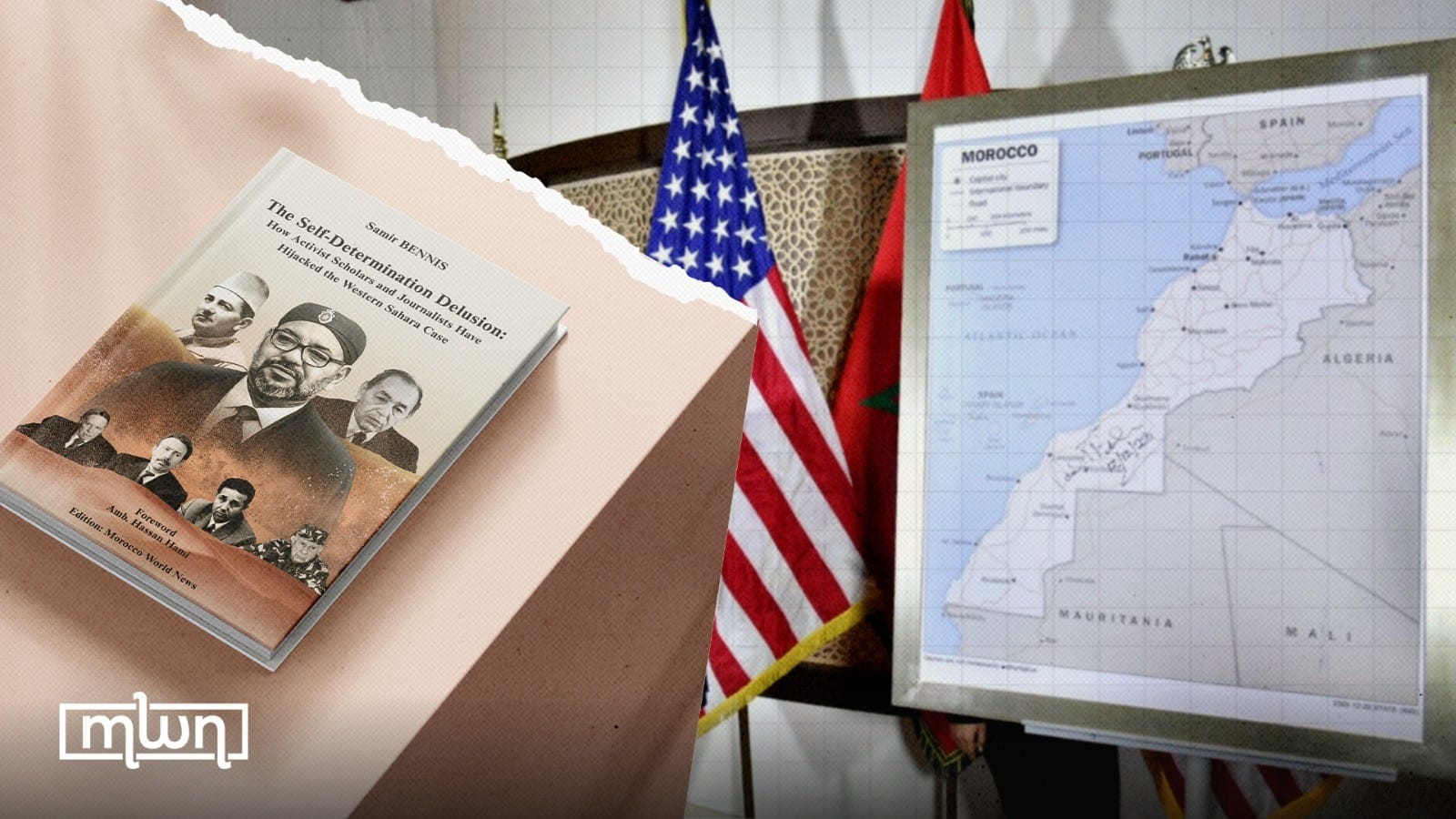
Delving into the challenges, misunderstandings, and misinformation surrounding this dispute, Samir Bennis’s recently released book, Self-Determination Delusion: How Activist Scholars and Journalists Have Hijacked the Western Sahara Case, engages the ideological underpinnings of the dominant Western Sahara discourse and debunks the misunderstandings and misinformation surrounding this dispute.
The book comprises 14 chapters, with each chapter delving into specific aspects of the dispute, highlighting major events such as Morocco’s defense of its sovereignty over the southern provinces and the hostile campaigns against the Moroccan position.
Key events discussed include the US recognition of Morocco’s sovereignty and a detailed history of the US position on the territorial dispute. One such event is the official recognition of Moroccan sovereignty over the Sahara by former US President Donald Trump.
This proclamation formalized Washington’s endorsement of Moroccan sovereignty over its southern provinces.
“The United States believes that an independent Sahrawi State is not a realistic option for resolving the conflict and that genuine autonomy under Moroccan sovereignty is the only feasible solution,” the proclamation reads.
Morocco has consistently expressed its satisfaction with the US position, which has long influenced many other countries to either align in supporting Morocco’s Autonomy Plan as the sole credible and serious political solution or consider doing so in the future.
The significant American policy shift has had far-reaching implications, and Samir’s book provides insightful details into both the making of this momentous policy shift and how it has decisively — almost irreversibly — changed the focus and direction of the ongoing UN-led political process.
Indeed, as Samir cogently shows throughout this first chapter of his almost 600-page foray into the ideological distortions that have long undermined genuine diplomatic efforts, the US proclamation is sure to significantly shape international discourse on the Sahara dispute.
Challenging the counter-narratives
As a detailed exploration of the US recognition — its historical background and its present and future implications — the first chapter of Samir’s book delves into usually overlooked but politically significant events that have contributed to the emergence of Morocco’s Autonomy Plan as the best hope for a genuine resolution and the best route to lasting and politically sustainable solution.
To do so, Bennis’ analysis notably zooms into December 10, 2020, now a historic major date in US-Morocco ties. This was the day when former President Donald Trump announced Washington’s recognition of Morocco’s sovereignty over its southern provinces in Western Sahara.
This long-sought decision sparked immediate controversy and opposition from the usual suspects, with the most vocal and influential Polisario sympathizers in the US — mostly former diplomats, ideology-driven scholars, and activist journalists — vehemently criticizing the move. Unsurprisingly, these critics of the momentous December 10 proclamation argued that it was “a blatant violation” of international law and contradicted the longstanding US policy on “self-determination.”
However, as the book asserts, there is fundamentally an outdated conception of self-determination as defined in the UN Charter. As such, the chapter shows how the Moroccan autonomy initiative, consisting of 35 points, meets the criteria for self-determination as defined by the UN.
The plan, which Morocco submitted to the UN in 2007, advocates for the preservation of Moroccan sovereignty while also granting broad self-governance rights to the local population in the southern provinces. This includes the election of independent legislative, executive, and judicial bodies all under Morocco’s sovereignty.
However, some former and current diplomats, scholars, and journalists have long sought loopholes to contradict Morocco’s position.
The book’s opening chapter lists several of these public figures who have staunchly opposed Morocco’s position under the guise of supporting the “self-determination” of “oppressed people.”
Yet, many of them have not kept up with or adapted their narrative to the latest developments on the ground, namely the increasingly apparent reality of the impossibility of a self-determination referendum aiming to create a breakout state in southern Morocco.
Bennis, who has been writing extensively on the Sahara dispute throughout his career as both a diplomat and academic, also reviews in his book the reaction of the media and campaigns against the US’ December 10 proclamation in support of Morocco’s territorial integrity.
In genuinely engaging the animating spirit and relative political significance of this unsurprising Morocco-bashing campaign, the book shows how and why the US stance on the Sahara conflict has significantly evolved over decades.
It documents, for instance, the Carter administration’s reluctance to support Morocco’s Sahara stance, which was eventually offset by increasing support under Reagan.
The book also exposes Christopher Ross’s biased claims against Morocco, highlighting how not just history but the latest developments in the region are at odds with the former UN envoy’s version of the past, present, and potential future of the Sahara.
Notably, during Ross’s tenure as an ambassador to Algeria, many US officials conveyed to the Polisario leadership that the Carter administration supported an outcome that would allow Morocco to maintain sovereignty over Western Sahara while also granting the local population broad autonomy.
And while Ross has long criticized the newfound US policy on the Sahara question as inconsistent with Washington’s reportedly historical support for self-determination, the reality is that the groundwork for supporting Moroccan territorial integrity had been laid decades before Donald Trump’s election to the presidency.
In this regard, Bennis extensively quotes CIA briefs and diplomatic cables to lend further credence to his deconstruction of what he sees as a misleading and bad-faith-driven version of the Sahara story. He notably shows that, contrary to claims that have assertively been pushed forth by Ross and other American critics of the December 10 proclamation, the tone and conclusions found in all strategic US documents from the 1980s hinted at a future US recognition of Morocco’s sovereignty.
In other words, Trump’s proclamation was not a sudden departure but rather the culmination of decades of a gradual alignment of US policy with Morocco’s position.
Further contextualizing the latest developments in the Sahara within geopolitical and historical dynamics, this chapter sheds vital light on how US policy influenced diplomatic efforts and decisively shaped the discourse surrounding the dispute.
What can America be thanked for?
Of course, the game-changing US recognition did not come easily but was instead the result of decades of behind-the-curtains diplomatic work and efforts, marking a tale of persistence. Behind the scenes, there was subtle yet pivotal American support for Morocco’s position on the Sahara, despite persistent advocacy for a self-determination solution.
America’s support for the Moroccan autonomy initiative can be traced back to significant diplomatic exchanges and decisions dating back to 1999. Underscoring this is a 2019 declassified US State Department document, which revealed that the US played a key role in the conception of a plan pushing for an option of a politically negotiated settlement under which Morocco would preserve its sovereignty while agreeing to broad autonomy for the locals.
Diplomatic meetings in February 2006, led by William Jordan, then director of the US State Department’s Office of Near Eastern Affairs, urged Moroccan officials to present their autonomy plan to the UN Security Council, the chapter details. The US position during this period was clear, emphasizing the impossibility of establishing an independent state in Western Sahara.
The momentum continued to grow following the adoption of Resolution 1720 on October 31, 2006, where the US voiced its support for negotiations towards a mutually acceptable solution under the principles of self-determination. This momentum enabled Morocco to gain ground and officially submit its autonomy plan to the Security Council in April 2007, a move that received American backing as the US was quick to applaud the proposal as “serious, credible, and realistic.”
Despite this endorsement, achieving a firm commitment from the US proved elusive over the next decade due to changes in US administrations. These changes influenced the narrative from positive neutrality during Hillary Clinton’s tenure as Secretary of State to diplomatic challenges under John Kerry. The dynamics were further complicated by diplomats like James Baker and Christopher Ross, whose tenures coincided with critical junctures in US-Morocco ties, often influenced by lobbying pressures and internal debates within successive administrations.
Bennis stressed that the impact of lobbyists within US foreign policy cannot be ignored, as active lobbying by former members of Congress and advocacy organizations play a significant role in shaping the country’s positions. This influence persisted despite affirmations of support for Morocco from the US administration.
Yet these challenges eventually failed to significantly derail US support for Morocco, with decades of intricate Rabat-Washginton diplomacy ultimately bearing fruit on December 10 of 2020 when the Trump White House ended any remaining ambiguity as to the US’ commitment to supporting Morocco’s territorial integrity.
While presenting readers with broad insights into the US position, Bennis zooms in on intersections of US policy regarding Morocco’s ties and its foreign policy approaches to cases like the Sahara dispute in each section.
Internal debates within US administrations
Bennis also examines the 2018 appointment of John Bolton as National Security Advisor, a move that sparked significant controversy in Rabat given his anti-Morocco position on the Sahara dispute.
Moroccan diplomats’ concerns over this appointment grew larger after Algeria, the main sponsor of the separatist Polisario Front, signed a lobbying contract with David Keene, a close associate of Bolton, through his firm Keene Consulting. In addition to the suspicious timing of this deal, the fact that the deal was worth $30,000 per month was ample evidence that this was to influence US policy against Moroccan interests.
As if his appointment and this thinly veiled lobbying deal was not enough, Bolton confirmed Morocco’s apprehensions in a December 2018 speech at the Heritage Foundation think tank. In it, he once again showcased his alignment with separatist claims by boldly advocating for a referendum of self-determination.
Yet despite Bolton’s efforts, his maneuvers faced significant internal and diplomatic challenges, Bennis argued, noting that Bolton’s tenure ended abruptly in September 2019 when Trump dismissed him over disagreements on foreign policy issues, including Iran and North Korea.
US policy subsequently reverted to a more traditional stance supporting Morocco’s autonomy initiative, a position upheld by the Biden administration following Trump’s proclamation—a recognition in line with international law.
But the lamentable end of the so-called “Bolton effect” did not effectively bring to a halt Algeria’s US campaign against Morocco’s territorial integrity. Both at the UN and on the lobbying front, Algiers and the Polisario leadership continued to court public opinion in the US by misleadingly presenting Morocco as an “occupying power” in the Sahara while condemning the US recognition of Morocco’s territorial integrity as a “clear violation of international law.”
To debunk this Algerian attempt at claiming the moral high ground, Bennis shows not just the historical Moroccanness of the disputed region, but also how the December 10 proclamation was in line with customary international law. His argument is that 17 years of consistent support for Morocco’s Autonomy Plan in UN Security Resolutions have created a new legal equation when it comes to settling the Sahara dispute: Morocco’s Autonomy Plan is the only viable way out of the region’s tragic saga.
In refraining from pushing for a self-determination referendum for Western Sahara since 2007 to instead stress the need for a politically negotiated solution, Bennis argues, the Security Council has decisively sidelined the notion of an independence referendum. Not only do Resolutions 2440, 2468, 2494, 2548, 2602, 2654, and 2703 underline the Security Council’s preference for a compromise-based solution, but their collective tone suggests that the UN no longer believes in the feasibility or usefulness of creating a new state in the region.
Because the Security Council is the arbiter of what should count as legal or illegal, preferable or dangerous when it comes to the Western Sahara question, Bennis suggests, those who still cling to a sidelined referendum are the ones who, in the current diplomatic configuration, are supporting an illegal and politically alarming position.