Doha – As the Gaza genocide enters its second year, the devastating humanitarian toll continues to mount.
According to the Gaza Health Ministry, over 42,000 Palestinians have been killed and nearly 100,000 injured since October 7, 2023, with women and children comprising the majority of casualties.
The fallout of the genocide has displaced most of Gaza’s 2.3 million residents, with many facing acute shortages of food, clean water and medical supplies.
The scale of destruction in Gaza is staggering. The Gaza Government Media Office reports that 902 Palestinian families have been entirely wiped out, with all members killed. An additional 1,364 families lost all but one member, while 3,472 families were left with only two survivors.
The October 7 attacks by Hamas killed approximately 1,200 Israelis, mostly civilians, and saw over 250 taken hostage into Gaza. The unprecedented nature and brutality of these attacks sent shockwaves through Israeli society, fundamentally altering the nation’s sense of security.
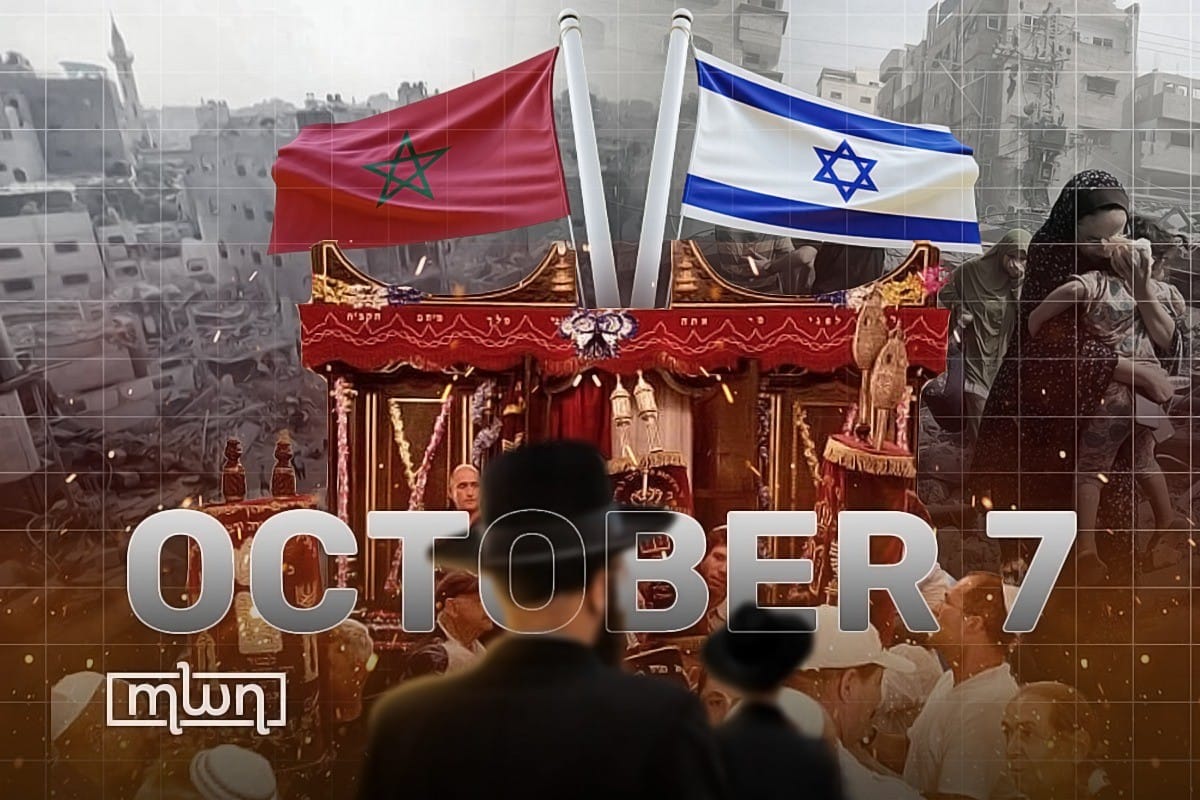
Amid this ongoing tragedy, Morocco finds itself in a complex position – balancing its normalization of bilateral ties with Israel against its historical support for the Palestinian cause and its cultural connections to both sides of the conflict.
Morocco’s unique role in the Israeli-Palestinian conflict is shaped by several factors: its longstanding Jewish heritage, its large diaspora community in Israel, and its history of mediation efforts. For centuries, Morocco was home to one of the largest and most vibrant Jewish communities in the Arab world. Even after the mass exodus of Jews following Israel’s founding, Morocco maintained connections with its Jewish diaspora.
This special relationship was exemplified by King Hassan II’s famous statement: “When a Jew emigrates, Morocco loses a citizen, but gains an ambassador.” This philosophy underpinned Morocco’s efforts to maintain ties with its Jewish community abroad, even as it advocated for Palestinian rights.
Morocco’s history of mediation in the conflict dates back decades. King Hassan II played a crucial role in facilitating the Camp David Accords between Egypt and Israel in 1978. Later, Morocco hosted classified talks between Israeli and Palestinian officials that helped pave the way for the 1993 Oslo Accords.
The country’s perceived neutrality and connections to both sides positioned it as a trusted intermediary. Even after severing official ties with Israel during the Second Intifada in 2000, Morocco maintained informal contact and continued to advocate for a two-state solution.
The 2020 normalization agreement between Morocco and Israel, part of the broader Abraham Accords, marked a significant shift in regional dynamics. The re-establishment of Israeli-Moroccan ties was seen as a key factor that contributed to Washington’s decision to recognize the North African country’s sovereignty over the Western Sahara. The move was also seen as potentially enhancing Morocco’s role as a regional mediator.
However, the current Israeli genocide on Gaza has put significant strain on Morocco’s carefully calibrated position. While maintaining official ties with Israel, Morocco has strongly condemned the high civilian death toll in Gaza and called for an immediate ceasefire. Large pro-Palestinian demonstrations have taken place in many Moroccan cities, reflecting widespread public sympathy for the plight of Gazans.
Yet unlike in 2000, Morocco has not cut ties with Israel over the conflict. Several factors may explain this difference in approach. The strategic benefits of normalization, including US support on the Western Sahara issue, likely play a role. Additionally, Morocco’s ties with its Jewish diaspora in Israel have deepened over the past two decades, creating stronger cultural and economic links between the countries.
Morocco’s Jewish community
The Moroccan Jewish community in Israel, numbering around 800,000 according to some estimates, represents a unique bridge between the two nations. Many Moroccan Jews maintain strong cultural ties to their country of origin, even as they have integrated into Israeli society. Cities in southern Israel with large Moroccan populations have streets and squares named after Moroccan kings, reflecting the community’s enduring connection to its roots.
However, this community has also been directly impacted by the October 7 Hamas attack, as well as the resulting ongoing Israeli genocide in Gaza. Many Moroccan Jews in Israel live in southern areas that have faced rocket attacks from Gaza. The October 7 attacks and subsequent war have left this community grappling with complex emotions – concern for family and friends in Israel, coupled with distress over the mounting civilian casualties in Gaza and the greater occupied West Bank.
To gain deeper insight into these dynamics, Morocco World News (MWN) spoke with three Israeli experts from different ideological perspectives. While mounting pro-Palestinian sentiment and anti-normalization voices dominate Moroccan media, the Israeli perspective is often overlooked.
Morocco’s diaspora: A bridge amidst conflict
In his comments to MWN, Aviad Moreno from the Azrieli Center for Israel Studies at Ben-Gurion University of the Negev (BGU), highlighted the unique position of Morocco in the Arab world and its special relationship with its Jewish diaspora. He notes that Morocco’s role as a mediator in the Israeli-Palestinian conflict has long been shaped by this perception of exceptionalism.
“The recent normalization agreements with Israel positioned Morocco as a key regional actor in peace efforts,” Moreno explains. “However, the current Hamas-Israel war presents significant challenges to this role.”
Moreno also spoke about the direct impact of the conflict on the Moroccan Jewish community in Israel. “Many Moroccan Jews reside in southern Israel, areas directly affected by the ongoing conflict with Gaza and the October 7th attacks,” he says. This proximity to the conflict zone has heightened the community’s stake in the ongoing escalation of violence.
According to Moreno, one reason for the strong Israeli reaction to the October 7 events is the systematic integration of Holocaust memory into Israeli collective consciousness. “The ties between Morocco and its diaspora in Israel are underpinned by a narrative of peaceful Muslim-Jewish coexistence,” he notes. “This is symbolized by the story of King Mohammed V’s protection of Jews during World War II.”
Despite their country’s years of conflict with Palestine and a tendency to support right-wing parties in Israel, Moreno observes that Moroccan Jews in Israel remain remarkably connected to Morocco. “Their reverence for Morocco’s royal family is evident even in the naming of streets and squares after Moroccan kings in Israeli cities with large Moroccan populations,” he says.
Moreno pointed out a unique aspect of Moroccan Jewish identity in Israel. “Many continue to see Morocco as a special ‘Jewish’ hub, and refer to Moroccans as ‘our Arabs’. This is in sharp contrast to how Algerian Jews, for instance, feel about Algeria. These Jews would barely say they are ‘Algerians’ but that they were ‘born in Algeria,’ unlike Moroccan Jews who more proudly identify as ‘Moroccans,’” he says.
In Moreno’s view, this unique cultural identity positions Moroccan Jews to strongly support Morocco’s continued mediation role. “The Moroccan-Jewish community could serve as a vital bridge in strengthening bilateral relations during these turbulent times,” he concludes.
The rightward shift of Moroccan Jews in Israel
Andre Levy, a Moroccan-Israeli cultural anthropologist and associate professor at BGU, currently based in Rabat, offered insights to MWN into the changing political landscape among Moroccan Jews in Israel. Levy, who identifies himself as being on the “very left side of the Israeli political map,” notes a rightward shift in this community’s political leanings.
“In relation to all Moroccan Jews in Israel, when you talk to them, the question of Israel-Palestine is much more lightweight,” Levy observes. He attributes this shift partially to broader trends within Israeli politics, particularly within the Likud party.
“The Likud party was not very external agenda-focused in the past,” Levy explains. “But I have to say that in the past, the Likud was more of a central to moderate right-wing party. In the last years, because of actions that Benjamin Netanyahu took, it became more and more radical to the right-wing.”
Levy sees this rightward shift as reflective of broader trends in Israeli society, particularly following the October 7 attacks. “What happened on October 7th actually turned this into an existential war,” he says. “That’s why you are willing to be way more careful. Because of the cruelness of Hamas.”
However, Levy believes Morocco can play a moderating role in these tendencies. “Here Morocco has an important role in moderating these tendencies,” he suggests. “The King can show that not all Arabs are the same, that you can live in peace with Muslim people.”
Reflecting on his current experience in Morocco, Levy notes that other than within some pro-Palestinian demonstrations, he hasn’t felt any personal animosity as an Israeli Jew. “I don’t think that the Jews here have something to fear,” he says. “The Jews here, they have their neighbors, they have their friends, their Muslims, and I don’t think that something will happen.”
Looking to the future, Levy remains cautiously optimistic about the prospects for peace, though he acknowledges it will take time. “I am sure that also within the Palestinians, they will realize that you cannot continue trying [to destroy Israel]. They have the best shot this time,” he says. “But this realization will take time, I am sure. It will not happen tomorrow or next year. But I am sure that it will come.”
Israel and Morocco: Common enemies, divergent visions
A hawkish, more traditionally Zionist perspective comes from Efraim Inbar, president of the Jerusalem Institute for Strategic Studies (JISS), an Israeli conservative security think tank, and a professor emeritus at Bar-Ilan University. Inbar argues that shared strategic interests, rather than cultural ties, are the primary driver of Morocco-Israel relations.
“Morocco and Israel have the same enemy, and that’s why their relations are not really impacted,” Inbar asserts. He points to Iran’s alleged support for the Polisario Front in Western Sahara as a key area of alignment between Moroccan and Israeli interests.
Inbar takes a skeptical view of Morocco’s potential as a mediator in the Israeli-Palestinian conflict. “Previous mediation roles did not work,” he states bluntly. Instead, he advocates for Morocco to focus on strengthening ties with Israel rather than prioritizing the Palestinian cause.
Controversially, Inbar argues against the establishment of a Palestinian state. “A Palestinian state should not exist as it will be either extremist like Hamas or corrupt like Fatah,” he contends. This position puts him at odds with Morocco’s official support for a two-state solution. Inbar further asserts that the Palestinian question “was not a condition” of the Abraham Accords.
Regarding the civilian casualties in Gaza, Inbar disputes the figures provided by Palestinian authorities. “Even if you double it, it’s not genocide,” he argues, echoing a common refrain among Israeli hardliners who view the casualty numbers as inflated.
Inbar’s views represent a strain of thought in Israeli politics that prioritizes security concerns over diplomatic engagement with the Palestinians. This perspective has gained traction in the wake of the October 7 attacks, complicating efforts at mediation and peace-building.
Read also: One Year After October 7: ‘Normalization Has Fallen Popularly and Must Fall Officially’