Rabat – The promotion of human rights, particularly the rights of children and women, remains the foremost concern for many in the international community as multiple wars turn into unprecedented humanitarian catastrophes in many regions around the world.
Throughout such unbearable cycles of wars and their accompanying crises, activists, NGOs, and global leaders routinely make pledges to address some of the most pressing challenges facing a world increasingly on the brink of collapse.
But do they ever succeed? There are no clear-cut answers as children in war zones and conflicts worldwide continue to suffer the consequences of circumstances they had no part in.
The challenges give rise to inhumane situations, including the absence of opportunities, starvation, and the denial of basic rights — such as the right to education.
But some initiatives offer a glimmer of hope, suggesting that with more efforts, improvements could be made. Among these initiatives is the Education Above All Foundation (EAA).

Glimpse of hope amid war darkness
Speaking to Morocco World News (MWN), Engagement Manager at Education Above All Abdullah Al Bakri shared the foundation’s perspective and mission.
In particular, Al Bakri noted that the foundation’s services have supported more than 19 million beneficiaries by providing them with access to high-quality education.
The foundation operates in over 60 countries via a network that exceeds 100 partners.
Established in 2012, the initiative frequently renews its commitment to supporting schools and communities in conflict zones.
The establishment of the foundation is in line with the vision of Sheikha Moza Bint Nasser, its founder and chairperson.
Many statistics and fact sheets highlight the educational gaps faced by students in war zones — where freedom seems like a crime, not based on principles, but dictated by occupying forces or senseless wars.
UNICEF data from 2017 said over 25 million children between 6 and 15 years old are missing out on school in conflict zones in 22 countries.
The number could be worse now as wars, conflicts, and relentless aggressions are targeting millions of civilians in many areas, including in the Middle East.
EAA seeks to help the children and youth of Gaza, a region engulfed in relentless campaigns targeting civilians.
“Its work is critical in conflict-affected regions where it supported 7 million beneficiaries alone,” Al Bakri told MWN, adding that the foundation’s mission focuses on ensuring that all children and youth have access to education — particularly those in vulnerable and marginalized situations.
Its goals include prioritizing policy and funding decisions, building temporary schools, providing learning materials, and supporting teachers in conflict areas.

Among the programs launched by the foundation to boost its commitments is the Al Fakhoora program dedicated to offer quality education for youth.
“Our goals align with addressing the global education crisis by empowering youth, fostering sustainable development and supporting communities inr regions affected by war,” he added.
Commenting on the foundation’s contributions in Gaza, Al Bakri said EAA has prioritized “uninterrupted education” despite challenges posed by the ongoing war.
The Fakhora program has launched a number of interventions to address the needs of children, youth and families.
One of these interventions is the Rebuilding Hope for Gaza initiative, which aims to restore hope through community development efforts and education.
The initiatives also include the National Program for Popular Education, whose aim is to help thousands of students access education.
The program strives to offer children with a safe and consistent learning environment.
Initiatives addressing food security, hygiene, and beyond
As part of the Fakhora program, over 100 scholarships have been granted to students in Gaza, enabling them to continue their studies.
In the occupied West Bank, the foundation provides 926 scholarships for Palestinian students at Birzeit University. The foundation aims to offer more scholarships in the near future, Al Bakri noted.
He stressed that the foundation has provided over 1m000 scholarships to Palestinian youth in Gaza since 2009. The scholarships were part of the program incorporating a “Civic Engagement” initiative that focuses on social responsibility and equipping youth to become leaders within their communities.
Similar efforts have enabled scholarship recipients to take lead and contribute as doctors, nurses, teachers and other professions.
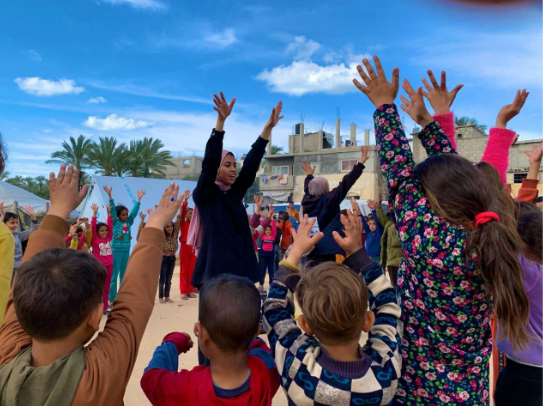
Beyond education, some of the EAA programs also include psychological support programs and recreational activities seeking to help children and youth cope with the trauma of war.
Some of the foundation’s initiatives also include distribution of dignity kits to thousands of women and adolescents, to enable them access to essential hygiene resources.
In this regard, Al Bakri recalled the youth-led initiatives supported by EAA, which have to date benefited 100,000 individuals while promoting local agency and community resilience.
“Local volunteers and youth play an essential role in the success of Al Fakhoora programs in Gaza, serving as the backbone of community-driven initiatives and embodying the transformative potential of education,” Al Bakri told MWN.
Humanitarian initiatives also address food insecurity in the region, by providing 172,000 hot meals to displaced families.