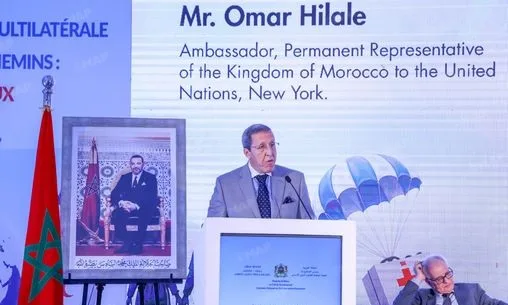
Agadir – Morocco reaffirmed its commitment to strengthening global humanitarian action, with Ambassador Omar Hilale stressing that the country’s approach is rooted in the humanist vision of King Mohammed VI and guided by principles of solidarity, shared responsibility and respect for international humanitarian law.
Speaking at the international colloquium “Multilateral humanitarian action at the crossroads: challenges and issues,” Morocco’s permanent representative to the United Nations outlined the principles guiding the country’s humanitarian approach.
Hilale said the implementation of the Royal Vision relies on three interconnected pillars: active solidarity as a fundamental value, shared responsibility as an operational principle, and respect for international humanitarian law as an absolute necessity.
Addressing a panel on “Multilateral Humanitarian Action and the Challenges of Peace and Sustainable Development,” the ambassador stressed that Morocco considers the protection of civilians, vital infrastructure and essential services a basic obligation that must be upheld by all parties involved in conflicts.
He recalled that Morocco remains one of the consistent contributors to UN peacekeeping operations, with thousands of Moroccan peacekeepers having served under the UN flag in several conflict and crisis zones around the world.
Read also: Guinea Thanks King Mohammed VI for Humanitarian Repatriation of Shipwreck Survivors
Hilale also noted that the country has repeatedly responded to major natural disasters and humanitarian emergencies, reflecting its long-standing commitment to international solidarity.
Hilale stressed that Morocco believes multilateral humanitarian action, despite facing limitations and challenges, remains an essential pillar of the international system. He called for its reform and adaptation through greater investment in prevention, stronger coordination with peace and development efforts, and renewed global solidarity.
Among the main challenges facing the humanitarian system, he cited funding shortages, restricted humanitarian access, the politicization of aid, prolonged forgotten crises, and the need to better connect emergency responses with sustainable development strategies.
He affirmed that Morocco’s experience in mediation, South-South cooperation, human development and humanitarian assistance provides the Kingdom with valuable perspectives to contribute to the reform and strengthening of the global humanitarian framework.
He called for faster responses to emerging crises, innovative financing mechanisms, stronger international cooperation, improved governance of humanitarian organizations, and enhanced partnerships between humanitarian actors and development institutions.
Hilale also stressed the need to strengthen coordination between humanitarian mechanisms and the UN 2030 Agenda for Sustainable Development.