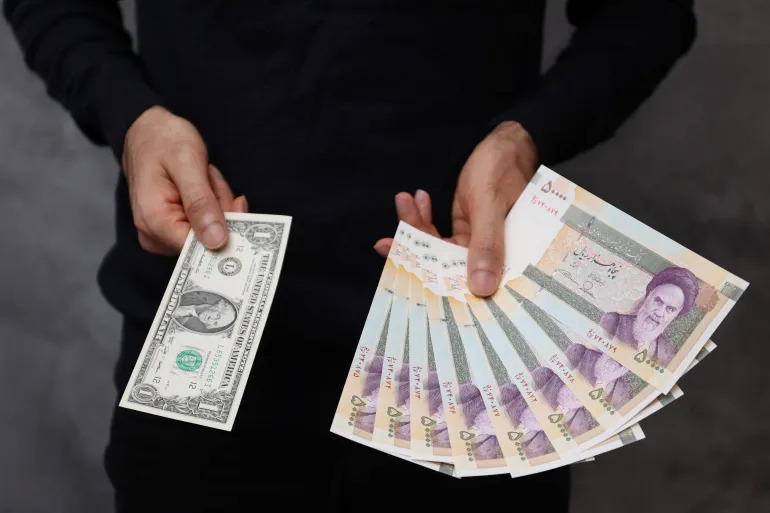
Rabat – Iran’s rial hit a record low on Monday, heightening concerns over the country’s deteriorating economic state as Washington readies a new round of sanctions.
While Iran’s Central Bank maintains an official exchange rate of around 1.5 million rials per US dollar, the currency traded at 2.02 million rials per US dollar on the informal market, the rate most Iranians encounter when buying foreign currency, according to the Associated Press.
Even before the US and Israel launched attacks on Iran on February 28, the country’s currency faced heavy pressure from double-digit inflation and negative economic growth; nearly six months of war have since driven the rial to repeated lows.
Rising prices deepen economic pressure
The economic strain is increasingly visible in essential food costs, with rice prices jumping by around 60% and beef prices surging by more than 150% since the war began.
Compounding concerns over inflation, sanctions, and months of war, the International Monetary Fund (IMF) projects Iran’s economy will shrink by more than 5% this year, placing further strain on households and businesses.
In downtown Tehran, a group of residents lined up to buy US dollars on Monday, with one man telling the Associated Press he was using his remaining savings to protect against further declines in the rial.
Washington prepares broader sanctions
Aiming to intensify economic pressure on Tehran, the Trump administration has pledged tougher sanctions against Iran, including secondary measures targeting entities and countries that maintain business ties with Tehran.
The growing pressure also follows the United Arab Emirates’ decision last week to suspend all trade with Iran, a major blow given that the UAE has long served as one of Tehran’s largest trading partners and its primary source of imports.
Warning against further escalation, Iranian Foreign Ministry spokesperson Esmail Baghaei stated on Monday that any heightened friction would carry consequences, adding that Tehran’s options to respond remain open.
Despite mounting economic pressure, Iran continues to hold strategic leverage through the Strait of Hormuz, where persistent attacks and security threats have brought maritime traffic nearly to a standstill.
Meanwhile, Iran and Oman are reportedly finalizing an agreement on a joint strategy to manage the Strait of Hormuz, with Oman’s Foreign Minister Badr Albusaidi scheduled to visit Tehran on Tuesday for talks.