
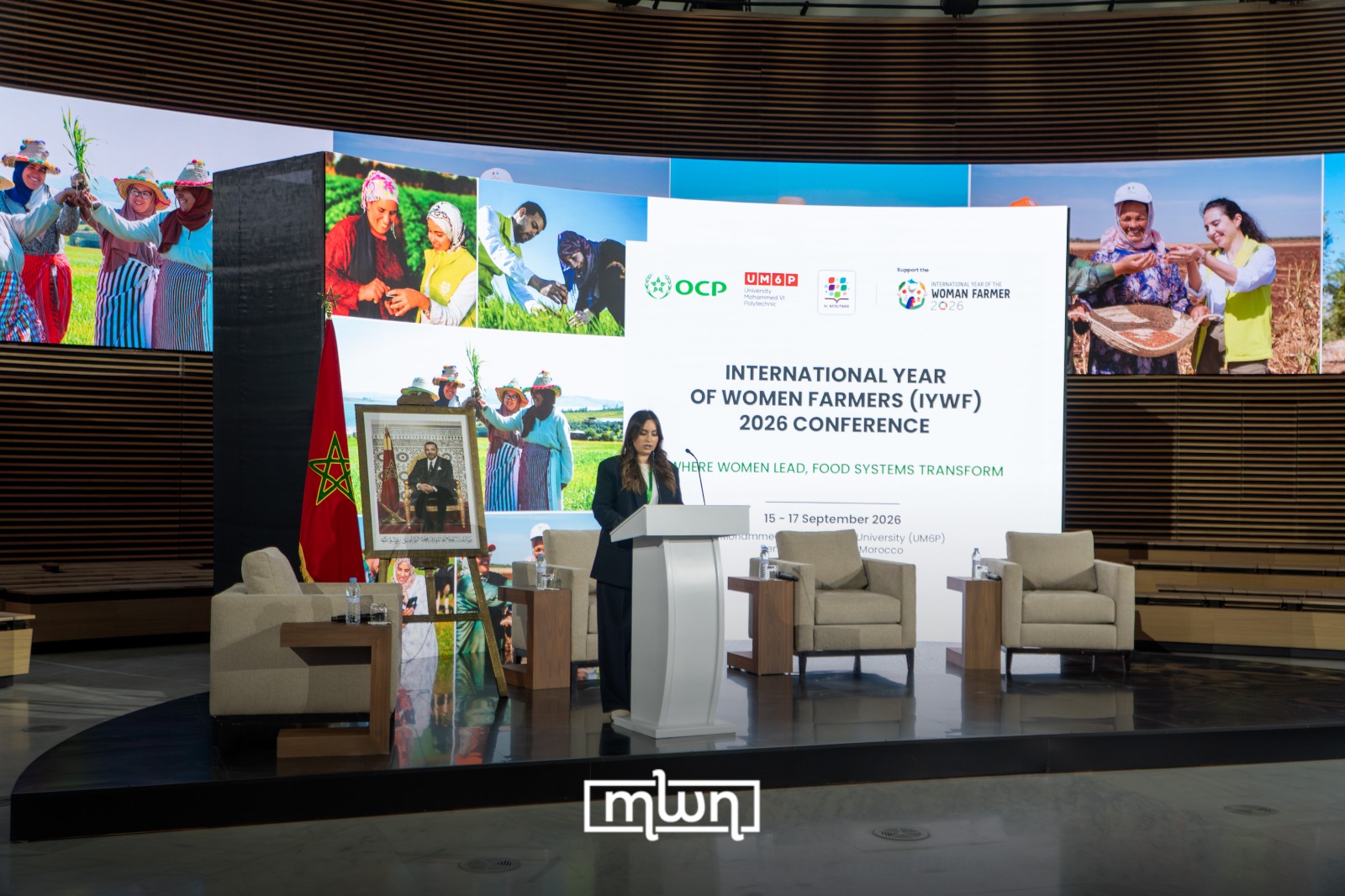
Benguerir – An international gathering on women in agriculture opened Tuesday at Mohammed VI Polytechnic University (UM6P) in Benguerir, built around a blunt premise: women already lead in food systems, and the real work is moving them from participation to economic power.
The OCP Group and UM6P are organizing the event through the Al Moutmir initiative, in partnership with the Food and Agriculture Organization of the United Nations (FAO), with the three-day meeting running September 15-17 under the theme “Where Women Lead, Food Systems Transform.”
It falls within the International Year of Women Farmers 2026, proclaimed by the UN General Assembly in resolution A/RES/78/279 of May 2, 2024, with Morocco as a co-author. The FAO facilitates the year alongside the International Fund for Agricultural Development (IFAD) and the World Food Programme (WFP).
View this post on Instagram
Opening the program, Rim Dakir, head of strategic stakeholder engagement for global affairs at OCP, framed the theme as fact rather than aspiration. “That title is not a slogan; it is an observation,” she told the audience. Women restore soils, steward nutrients, diversify crops, build businesses, and transmit knowledge, she noted, yet barriers to land, finance, technology, advisory services, markets, and recognition remain.
The question, in her remarks, “is not whether women lead – they already do,” but what it takes to move “from participation to agency, from recognition to opportunity, and from successful local solutions to lasting scale.”
The numbers behind the discussion are large. Closing gender gaps in agricultural productivity and pay could add close to $1 trillion to global GDP and lift 45 million people out of food insecurity, according to FAO 2023 figures cited by organizers. More than 500 million women work in food, land, and water systems worldwide, per CGIAR’s 2025 flagship report.
The economic case for closing the gap
The first panel, which Omar Farhate of Emerging Ag moderated, cast women farmers as economic actors rather than beneficiaries.
David Laborde, director of the FAO’s Agrifood Economics Division, laid out the cost of inaction. Women make up 40 to 60% of farmers depending on the country, he explained, but their productivity per hectare runs about a quarter lower than men’s – not for lack of skill, but for lack of inputs, land rights, and credit.

That shortfall means less food, lower rural incomes, and more land cleared to produce the same output. For every dollar men earn in the food system, women earn roughly 17 cents. Closing the productivity gap alone could generate $1 trillion in value, equal to 0.8% of global GDP and 20% of the value of agricultural production.
“We will not get to 2050, with 9 to 10 billion people to feed well, if half the farmers at the base of the system are not fully equipped,” Laborde told the panel, tying the argument to pragmatism as much as fairness.
In an interview with Morocco World News (MWN) on the sidelines, Laborde placed Morocco’s trajectory in a longer arc. The FAO, created 81 years ago, exists to reach a world without hunger while managing natural resources, he told MWN. Over 25 years, he observed, Morocco has “done a lot of efforts and investments to transform its agri-food system,” shifting from producing more food toward producing it more sustainably. He warned that climate and drought shocks, which often hit women hardest, could erode gains already made.
Sabra Machrouhi, who heads cooperative-sector promotion at Morocco’s Office of Cooperation Development (ODCO), brought the institutional view. The national register holds more than 69,000 cooperatives with over 800,000 members, about 34% of them women. But “participation is not agency,” she cautioned, distinguishing cooperatives that merely pass along income from those that build power by three tests – who decides, who sells, and who keeps the surplus.
On policy, Law 62.17 of 2019 brought equality to collective land after “decades of customary exclusion,” though women still struggle to claim those rights. Green Generation 2020-2030 targets more than 18,000 new cooperatives by 2030, and Morocco’s social-economy strategy aims for 8% of GDP and 50,000 jobs a year by 2035, with 30% of public procurement reserved for small firms and cooperatives since 2023. Her single priority: training and market certifications, without which cooperatives never move beyond local buyers.
Harry Shawyer of the WFP Innovation Accelerator argued for a change in language and mindset. The agency works in 120 countries but not Morocco, since it operates only where governments invite it.

He called for retiring the word “beneficiary” in favor of a business framing. WFP’s SheCan program pairs low-interest loans with financial, digital, and business training; over four years it has grown from one country to nine, with women accounting for 63% of participants and a loan default rate of 0.01%. In some settings it adds gender-based-violence training and brings men and boys into the program to ease household tensions when women’s earnings rise.
A video contribution from Ismahane Elouafi, the Moroccan executive managing director of CGIAR, closed the session. Recognition is not enough, she argued; the conditions in which women innovate must change, and science “must begin with the right question.” Her message to women in the field: “Do not wait for someone to give you permission to lead.”
Making women visible in data and design
The second panel turned to science, data, and innovation. Lamiae Ghaouti, director of Morocco’s National Institute of Agronomic Research (INRA), opened with a warning about measurement. “If women are not seen in our data, then they cannot be seen in our policies,” she told the audience. Research counts farms and households, rarely the women inside them.
Ghaouti drew three distinctions – ownership is not control, participation is not decision, access is not empowerment – and pushed back on treating gender as a standalone category. At INRA, women make up 30% of staff, 50% of PhD holders, and 60% of recent hires, with no gender-preference policy behind it: “where you have no positive discrimination, women will rise.”

Speaking to MWN afterward, Ghaouti pointed to the one-million-hectare conservation-agriculture program led by the Ministry of Agriculture with OCP, Al Moutmir, and the International Center for Agricultural Research in the Dry Areas (ICARDA).
The direct-seeding method reaches 120,000 women and, by removing the need for manual weeding, saves an estimated 10 million hours a year of physical labor, she told MWN. Because that work is repetitive and done stooped in the field, cutting it reduces the strain on women’s bodies – lowering the estimated incidence of field-related joint disorders by about 35%. The freed-up time also shifts women toward higher-value work such as legume processing. “Women participate by 50%,” she added – the open question is “whether they capture 50% of the value.”
Joining remotely, Pooja Bhatnagar-Mathur of the joint FAO/IAEA center described the route from science to impact as anything but linear, with farmers as co-creators rather than recipients. She cited pearl millet, where a rancidity trait went unaddressed for years even though women grind flour every few days – a burden that traits for time-saving and nutrition, not just yield, could ease.
Dina Najjar, senior gender scientist at ICARDA-CGIAR, argued that science serves women only when it makes them visible. Across the MENA region, women are often “labeled as housewives on their national IDs,” which locks them out of pensions and credit. ICARDA has rewritten extension messages – the advisory notes that carry farming guidance – which once addressed only “dear brother farmer.”
Such language assumed the farmer is a man and quietly wrote women out, a direct reflection of how women are often invisible as farmers – socially and even legally. The messages now include and reach women too in Tunisia, Egypt, and Iraq, and ICARDA has distributed phones to women who otherwise could not receive digital advice at all.
On technology, she pointed to “naked” barley, a hull-free variety that needs less threshing; because a clinging hull can cost up to 25% of the yield in processing, the trait both raises income and eases the labor women typically do. But the reverse can also happen: machine-harvestable varieties cut labor yet displace women who depend on harvest-season wages, which is why ICARDA now takes a “do-no-harm” approach – scoring each breeding trait as neutral, beneficial, or harmful for women and flagging job losses to policymakers who can retrain those affected.

Jamila Adani, head of farming development at Al Moutmir, closed the panel on adoption. A solution can be technically sound and still fail, she explained; it must be relevant, affordable, and above all trusted, because “trust comes when you are giving clear evidence on the field, not theory in the lab.” Peer learning carries the most weight, since “farmers believe each other more than they do a scientist.” Her summary: “relevance answers the need, science brings the evidence, but trust brings the action.”
From the plenary to the field
The morning plenaries fed into three parallel afternoon masterclasses – on cooperatives and the social economy, advisory and extension at scale, and soil health and women’s territorial resilience – before a report-back on priority actions for scale.
The program narrows over the next two days. Wednesday is given to a closed FAO technical workshop on the Global Roadmap for Achieving Food Security in the Context of Climate Actions, led by Laborde and open by invitation only. Thursday moves to the field in Rhamna province, with visits to Al Moutmir demonstration plots in the Gantour area and a women-led cooperative at Sidi Bouathman, organized around a single question: what works, what remains difficult, and what can be replicated and scaled.

The gathering was built as a dialogue among the many actors who shape agricultural transformation. It brought together women farmers and cooperative representatives, scientists and researchers, advisory and extension practitioners, entrepreneurs and innovators, public institutions, international organizations, financiers, and agricultural experts, alongside the wider OCP and UM6P ecosystem. That breadth was the design, meant to move knowledge across field experience, science, innovation, public policy, and investment.
Organizers built the event on the premise that transformation “will not happen in silos” but in coalition, with governments, research, universities, the private sector, and local organizations connecting their strengths to move together from innovation to impact.
The priorities they set out ran from soil health and resilient value chains to gender-responsive advisory services designed for adoption rather than mere reach. And the closing message reframed the ambition itself: not simply to reach more women, but to redesign food systems around their realities – turning access into adoption, adoption into value, and value into lasting impact.