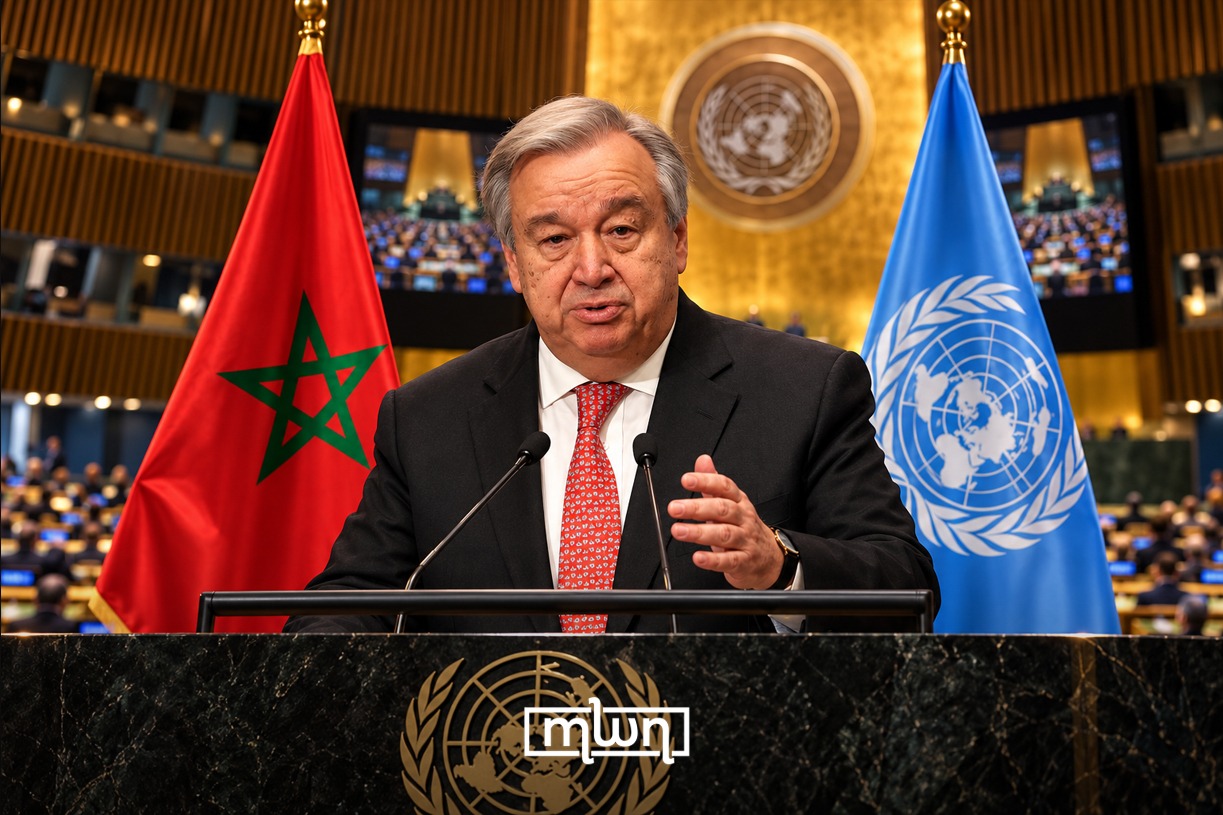
Marrakech – New York is entering its annual Morocco’s Western Sahara season, and the latest UN Secretary-General report on the territory does what a year of closed-door diplomacy refused to do. It records what the parties actually negotiated, and the centerpiece is a proposed transitional council tied to a transition phase that would carry the territory from conflict toward autonomy.
The document, S/2026/781, is dated October 1. It reached the fifteen members of the Security Council as an advance, preliminary copy, circulated for information. It has not yet been issued publicly as a live, clickable UN document, so what is available for now are extracts and an unofficial reading of a provisional version.
The timing is not accidental. The Council opens closed consultations on Wednesday, October 7, to begin deciding the future of MINURSO, the peacekeeping mission whose mandate runs out on October 31.
This is the first annual report from António Guterres to cover a full twelve months under Resolution 2797, adopted on October 31 last year. That resolution consecrated Morocco’s autonomy initiative as the basis of any negotiation. The new report measures what that change produced.
The first time since the 2019 Geneva roundtables
The core of the account sits in its section on the political process. For the first time in seven years, Morocco, the Polisario separatists, Algeria, and Mauritania returned to direct talks – three rounds in early 2026. The first ran in Washington on January 18 and 19, the second in Madrid on February 8 and 9, the third again in Washington on February 23 and 24.
Staffan de Mistura, the UN Secretary-General’s Personal Envoy for Western Sahara, co-chaired the rounds with Michael G. Waltz, the US Permanent Representative to the United Nations, with active support from Massad Boulos, the US president’s senior adviser for Arab and African affairs.
Morocco, Algeria, and Mauritania were represented throughout by their foreign ministers, Nasser Bourita, Ahmed Attaf, and Mohamed Salem Ould Merzoug, respectively. The Polisario sent its foreign policy official. The negotiations took Morocco’s autonomy proposal as their base, in line with Resolution 2797.
The transition architecture surfaced in Madrid. There, the participants examined the creation of a transitional council – a body that would manage various transitional processes and also, in the report’s terms, offer a space to negotiate the details of a just, durable, and mutually acceptable solution.
The same round opened discussion on the role of international actors and the guarantees of implementation. Delegations tabled ideas on resource-sharing, on amnesty and reconciliation, on disarmament, demobilization, and reintegration, on security measures, and on electoral systems.
Mauritania, the least involved of the four, pressed for a commission to clarify by consensus the definitive and permanent international borders of the territory.
What came next moved the process from concept to draft. At the participants’ request, UN and US teams worked together, during and after the Madrid round, on a preliminary draft framework agreement covering a possible transition phase, along with compromise positions on the areas already raised. The teams prepared several documents for the third round.
In Washington, in late February, the transitional council returned for in-depth discussion, alongside the other elements the UN and US teams had drafted.
Where the talks hit their limit
The same round exposed the limit. It opened a debate on self-determination and sovereignty over the territory, which the report calls the most controversial elements in the search for a solution. Faced with wide divergences, the co-chairs decided those two questions should be handled with each party separately.
That decision produced the round of bilateral meetings de Mistura held between March and June. He met the Polisario in Brussels on March 23, Algeria in Brussels on April 1, and Morocco in New York on April 21 and 23.
He then traveled to Tindouf on June 7 and 8 to meet the Polisario leadership, including its secretary-general, Brahim Ghali. He met Algeria’s foreign minister, Attaf, in Algiers on June 15, and the president of Mauritania, Mohamed Ould Ghazouani, in Nouakchott on June 18.
After those consultations, de Mistura and his co-chair reviewed the areas of relative consensus and produced a revised draft framework agreement for a transition period. If it is adopted, the report notes, that framework could serve as the basis for negotiations on a detailed model of self-governance for the territory and for a meaningful process of consultation with the population.
Guterres returns to the same idea in his conclusions, where he describes a framework agreement followed by a transition period as the arrangement most likely to let negotiations proceed in the best possible conditions.
One detail stands out by its absence. The report does not identify who first proposed the transitional council, nor who originated the framework agreement. The architecture is on the record; its authorship is not.
Around that core, the report fills in the context. Morocco entered the first round with the developed version of its 2007 plan and handed the co-chairs and the other parties a “Draft Autonomy Statute,” a document kept off public release because it was built as a negotiating base, not a final text.
The diplomatic field moved in the same direction. The European Union updated its common position in January to state that negotiations should take Morocco’s proposal as their base. Sweden and Switzerland backed the plan; Madagascar, Canada, and Japan reaffirmed their support; Mali and Honduras suspended their recognition of the self-declared “SADR”; Bolivia suspended relations with it outright.
On the humanitarian track, de Mistura and the UN refugee agency (UNHCR) proposed voluntary “go and see” visits for Tindouf refugees to Laayoune and Dakhla, so they could judge conditions and the autonomy plan for themselves. The proposal carried the US Permanent Representative’s co-signature. On September 14, the Polisario replied that it was ready to cooperate with UNHCR on putting it into effect.
The report is candid about the obstacle that remains. The confidence deficit, especially between Morocco and the Polisario, is named as a major barrier to any solution that can actually be implemented, which is why de Mistura pairs short-term confidence-building with strong long-term international guarantees.
On the mission itself, Guterres recommends extending MINURSO for another year, until October 31, 2027, while tying any change in its configuration to the political process. That recommendation followed a strategic review by Asif R. Khan, who cautioned against premature changes to the mission’s structure or mandate while negotiations were under way – a line the Council accepted despite US pressure to cut the mission’s funding.
The shift over twelve months is the report’s plainest message. The question is no longer autonomy or a referendum. It is how to implement autonomy – through a transitional council, a transition phase, and the guarantees to hold them in place – even as Guterres insists that any outcome pass through a free consultation of the population, with the right to accept or reject it.
Read also: UN Chief Says Resolution 2797 Gave Western Sahara Renewed Momentum