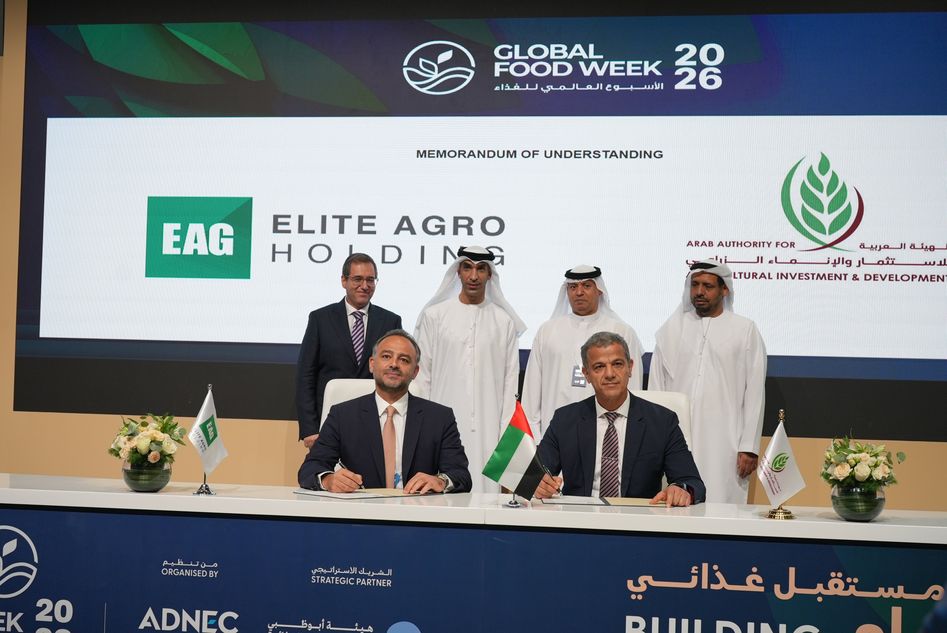
Marrakech – UAE-based Elite Agro Holding will develop its eighth farm in Morocco under a memorandum of understanding signed with the Arab Authority for Agricultural Investment and Development (AAAID). The agreement commits AED 140 million, roughly MAD 381 million ($38.1 million), to the Sidi Yehia Farm, a project covering about 400 hectares.
The deal was unveiled during Global Food Week 2026, held from October 6 to 8 at the ADNEC Centre in Abu Dhabi. It forms part of a wider AED 660 million package that the group announced across the UAE, Morocco, and Mauritania, spanning more than 9,300 hectares in total.
In Morocco, the Sidi Yehia project will focus on high-value crops, including blueberries, mandarins, and avocados. The farm is expected to raise the group’s output for both domestic and international markets, widening a presence that Elite Agro has built across several Moroccan regions.
The latest commitment follows a milestone the group reported in June, when it inaugurated its seventh farm in the country. That 200-hectare site in Kenitra, dedicated to premium blueberry and raspberry production, pushed Elite Agro’s direct investments in Morocco past AED 500 million ($136.1 million).
Those investments have contributed to more than 8,000 jobs, placing the group among Morocco’s significant foreign investors in agriculture.
Through its Moroccan subsidiary, Elite Harvest Maroc, the group operates production sites across Kenitra, Sidi Yehia, Fez, Beni Mellal, Sefrou, Marrakech, and Benslimane.
These sites cultivate a range of crops that includes blueberries, raspberries, pomegranates, pears, apples, peaches, nectarines, grapes, cherries, citrus fruits, persimmons, and plums. The operations hold certifications such as GLOBALG.A.P., GRASP, Tesco Nurture, SPRING, Field to Fork, and SMETA.
Hassan Halawy, Group CEO of Elite Agro Holding, framed the new investments as a fresh phase for the company in strategic markets. The expansion across the three countries, according to Halawy, reflects a vision for sustainable growth and closer partnerships that will “contribute to food security, create jobs and build local capabilities.”
He has previously described Morocco as the group’s largest berry production platform.
Thani Bin Ahmed Al Zeyoudi, the UAE Minister of Foreign Trade, tied the package to cross-border cooperation on food supply. Developing a sustainable agricultural sector, in his account, depends on combining “capital, expertise and advanced technologies” to build lasting production capacity.
Obaid Al Zaabi, Chairman of AAAID, cast the partnerships as a step in Arab cooperation on agricultural investment.
Beyond Morocco, the package allocates AED 440 million to the Aftout/Rosso project in Mauritania, which covers roughly 8,900 hectares and targets about 244,000 metric tonnes of produce. A further AED 80 million will fund a 25-hectare blueberry project in Al Ain in the UAE.
Morocco also took part in Global Food Week through a national pavilion organized by the Agency for Agricultural Development (ADA) under the Ministry of Agriculture, Maritime Fishing and Water and Forests.
The pavilion presented more than 100 products under the “Terroir du Maroc” label, drawing on 25 groupings and over 770 small farmers, among whom rural women accounted for close to 42%. The participation fell under the Génération Green 2020-2030 strategy, with B2B meetings and a “hosted buyers” program aimed at new markets in the Middle East.
Read also: Abu Dhabi Dates Exhibition 2026 Brings International Delegations Together